|
When you first walk into a dojo, you notice that the students are wearing white uniforms and belts of various colors. You may wonder what is the significance of the different color belts. The belt colors signify the approximate Martial Art skill levels of the wearers. Colored belts signify the position/rank of each student in the dojo hierarchy. The higher the belt/rank, the higher the position, and the more respect deserved. After years of studying and training, a student may reach the top of the belt/rank hierarchy, the black belt level. Since rank is awarded based on tenure, performing certain minimum skills, and on making substantial personal improvement, it is a more a social and psychological status than it is an indicator of fighting ability. A higher rank many times indicates the person has higher tenure in the dojo/organization, not necessarily that the person has a higher skill level than persons of lower rank. Skill level does not always equate to rank. Just because a young brown belt may be able to consistently beat an older student while sparring, it does not demean the student nor raise the brown belt’s esteem. While the goal of each student in Martial Arts is self improvement, the belt in some forms of it offers the student a way to display their efforts to the other students. It is also designed to help students engage in fair sparing activities. To respect the culture of Martial Arts, it is important that you wear the belt properly. |
|||||
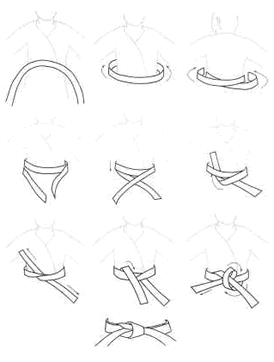 |
How to tie the belt (Obi) | ||||
| 1)Hold belt at its center, ends even, with stripes (if you have them) on the left side. | |||||
| 2)Place center of belt on front center of jacket, about one inch below the naval (a location called the tanden). Wrap belt around your waist, crossing the right side over the left side at center of the back. Stripes will now be on your right side. Pull ends of belt forward and adjust so the ends are even. | |||||
| 3)Lay the left side of belt over the tanden. Lay the right side of belt across the tanden. Stripes will now be on your left side. | |||||
| 4)Slide the left side of belt (striped side) under and behind all the belt layers at the tanden. Stripes will still be on your left side. | |||||
| 5)Loop | |||||
| 6)Bring left (striped) end of belt down and over the front of the U | |||||
| 7)Loop striped end under and up through the U shape to form a knot. | |||||
| 8)Pull ends of belt outward to tighten knot. Stripes will be on your right side. | |||||
| 9)Adjust knot so the ends of belt are even and hang neatly. | |||||
|
Never let a white belt get dingy or dirty. The belt needs to be tied firmly above the hip bones. Make sure it is loose enough to move during your activities but tight enough to stay in place. The ends of the belt hanging on both sides need to be even. This can take time to learn so practice finding the amount of material needed to tie it. Some people place a small marker on the inside of the belt to find the location easily. The belt should never be allowed to cross itself in the back. Never let your belt touch the floor. Having the proper respect for the Martial Arts includes honoring the belt color system. Never wear a belt for a level of skill you have not accomplished. This is considered to be dishonorable. Your instructor will help you learn to tie your belts properly. Enjoy learning about Martial Arts, improving your skills, and proving you are worthy of a higher ranking belt. |
|||||
|
KYU RANK – COLOURED BELTS Kyu-level practitioners are often called mudansha (無段者), “ones without dan” and are considered as initiates rather than students. When practitioners have reached the ranking of first degree black belt, they become shodansha (初段者). The holder of a black belt of any degree is a yūdansha (有段者), “one with dan”. |
|||||
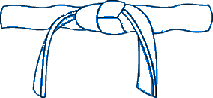
| 10 | Jūkyū | 十級:じゅうきゅう | White Belt |
|
|
| 9 | Kukyū | 九級:くきゅう | Advanced White Belt |
|
|
| 8 | Hachikyū | 八級:はちきゅう | Blue Belt |
|
|
| 7 | Nanakyū, Shichikyū | しちきゅう 七級:ななきゅう |
Advance Blue Belt |
|
|
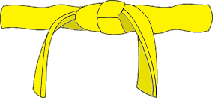
| 6 | Rokkyū | 六級:ろっきゅう | Yellow Belt |
|
|
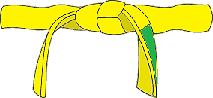
| 5 | Gokyū | 五級:ごきゅう | Advance Yellow Belt |
|
|
| 4 | Yonkyū | 四級:よんきゅう | Green Belt |
|
|
| 3 | Sankyū | 三級:さんきゅう | Advance Green Belt |
|
|
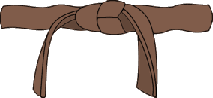
| 2 | Nikyū | 二級:にきゅう | Brown Belt |
|
|
| 1 | Ikkyū | 一級:いっきゅう | Advance Brown Belt |
|
|
|
In some styles, students wear white belts until they receive their first dan rank or black belt, while in others a range of color is used for different kyū grades. The wearing of coloured belts is often associated with kyū ranks, particularly in modern martial arts such as karate and judo (where the practice originated). However, there is no standard association of belt colours with particular ranks and, different schools and organizations assign colours independently, see judo for examples of variation within an art. However, white is often the lowest ranked belt and brown is the highest kyū rank, and it is common to see the darker colors associated with the higher ranks, i.e the closest to black belt. The system of using different colored belts to mark rank is not universally accepted in the martial arts, some seeing colored belts as frivolous, as anyone without at least a first-level black belt is still very much learning the basics. Supporters point out the use as a simple visual key for experience, such as in matching opponents for sparring, allowing opponents to somewhat accurately judge each other’s skill, and to split them for competitions. Those who oppose the use of coloured belts are also often concerned that students will worry too much about relative rank, and become arrogant with trivial promotions and differences, while supporters feel that by providing small signs of success and recognition, students are more confident, and their training is more structured, and that the ranking system encourages higher ranked students to assist lower ranked ones, and lower ranked students to respect their seniors. DAN RANK – BLACK BELT Warning: a black belt is only a black belt—your rank is your Dan or Kyu rank. Anyone one can buy a belt that’s black. It’s like putting a title of DR. in front of your name and claiming to be an actual DR. You only become a DR. by having the diploma from an accredited medical school to prove it. This is true of every college degree. The martial arts world is full of people claiming “black belt” rank who have never heard of the Dan and Kyu rankings, and instructors claiming to be an “instructor” without anyone’s certification or recognition of such. Remember: A Black Belt is only a piece of colored cloth. Your actual rank or “grade” is your authentic diploma—properly awarding a Dan or Kyu rank which is the universally accepted standard by all major systems: Japanese, Korean and Okinawan. The Chinese have their own ranking system, however they have had to accept the “karate” standard for rank. This is shown when they put anyone in competition and they must place their student according to “belt rank”. As a matter of fact, many Chinese systems have now adopted the colored belt system. |
|||||
| SHO-GO (Master – Title System ) DAN/DEGREE | |||||
| 1 |  |
 |
Senior |  |
|
| SEN | PAI | ||||
| Shodan | 初段:しょだん |
1st Dan (Black Belt) |
|||
| 2 | Nidan | 二段:にだん | 2nd Dan (Black Belt) |  |
|
| 3 | Sandan | 三段:さんだん | 3rd Dan (Black Belt) |  |
|
| 4 |  |
 |
Polished Instructor |  |
|
| REN | SHI | ||||
|
 |
Teacher | |||
| SEN | SEI | ||||
| Yondan | 四段:よだん | 4th Dan (Black Belt) | |||
| 5 |  |
|
Professor | 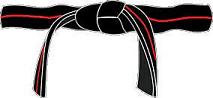 |
|
| KYO | SHI | ||||
| Godan | 五段:ごだん | 5th Dan (Black Belt)or Red/Black Sections |  |
||
| 6 |  |
 |
Master Instructor |  |
|
| SHI | HAN | ||||
| Rokudan | 六段:ろくだん | 6th Dan (Black Belt)or Red/Black Sections |  |
||
| 7 | 主席 | |
Chief Master Instructor |
 |
|
| SHU SEKI | SHI HAN | ||||
| Shichidan | 七段:ななだん | 7th Dan (Black Belt)or Red/White Sections |  |
||
| 8 | |
|
Senior/Grand Master |  |
|
| HAN | SHI | ||||
| Hachidan | 八段:はちだん | 8th Dan (Black Belt)or Red/White Sections |  |
||
| 9 | Kudan | 九段:きゅうだん | 9th Dan (Black Belt)or Red |  |
|
 |
|||||
| 10 | Judan | 十段:じゅうだん | 10th Dan (Black Belt)or Red |  |
|
|
The difference between Shihan & Hanshi The “shi” in shihan means teacher or master. The “shi” that’s used in hanshi means (gentle)man, samurai or warrior, or scholar.Hanshi is also “teacher of teachers” Japanese uses a broad array of honorific suffixes for addressing or referring to people. These honorifics are gender-neutral and can be attached to first names as well as surnames. Kōhai (後輩) is a junior, the reverse of senpai, but it is not normally used as an honorific. Shidōin (指導員:しどういん), intermediate instructor, also unrelated to grade. Shishō (師匠 : ししょう) is another title used for martial arts instructors. Sensei (先生) (literally meaning “born before me”) is used to refer to or address teachers, doctors, politicians and other authority figures. It is used to show respect to someone who has achieved a certain level of mastery in an art form or some other skill, and is also applied to novelists, poets, painters, and other artists, including manga artists. In Japanese martial arts, sensei typically refers to someone who is the head of a dojo. As with senpai, sensei can be used not only as a suffix, but also as a stand-alone title. Renshi (錬士: れん): Ren means “polished, tempered” and shi means person. Kyōshi (教士: きょうし) mean Professor or philosophy. Therefore Kyoshi equals a professor capable of teaching the philosophy of the martial arts. Kyoshi is someone who holds the rank of 5th Dan. Shihan (師範 : しはん), merely means chief instructor; unlike the titles above it is not related to grade. (In the Isshin-ryū school of karate-do, Shihan is used to refer to a 6th degree black belt. Shuseki Shihan (師範 : しはん) is a Senior Master and holds the rank of 7th Dan. Hanshi (範士 : はんし) The Han means ‘example, model’ and indicates ‘ a teacher that can serve as an ideal model fore others.It also refers to a senior expert considered a “teacher of teachers”. This title is used by many different arts for the top few instructors of that style, and is sometimes translated “Senior Master” or even “Grand Master”. Soke: The head of a family (such as a patriach) or “originator” or “founder” . This meaning the person who formed the particular martial art style. In the Japanese martial arts, the further subdivisions of black belt ranks are called dan grades where higher numbers means higher rank. Yūdansha (roughly translating from Japanese to “person who holds a black belt”) describe those who hold a black belt rank. While the belt remains black, stripes or other insignia can be added to denote seniority. In some arts, very senior dan grades will wear differently colored belts such as in judo and some forms of karate where a fifth dan will wear a red and white belt, which becomes red only at even higher ranks. In contrast to the “black belt as master” stereotype, a black belt commonly indicates the wearer is competent in a style’s basic technique and principles.Since in many styles a black belt takes approximately three to six years of training to achieve, a good intuitive analogy would be a bachelor’s degree: the student has a good understanding of concepts and ability to use them but has not yet perfected their skills. In this analogy a master’s degree and a doctorate would represent advancement past the first degree. Another way to describe this links to the terms used in Japanese arts; shodan (for a first degree black belt), means literally the first/beginning step, and the next grades, nidan and sandan are each numbered as “ni” is two and “san” is three, meaning second step, third step, etc. The shodan black belt is not the end of training but rather as a beginning to advanced learning: the individual now “knows how to walk” and may thus begin the “journey”. |
|||||
|
HISTORY OF THE WHITE TO BLACK BELT SYSTEM All you need to do is observe the well-worn belt of a high-ranking Black Belt to see through this fantasy. In fact the reverse is more likely true — look at that black belt and you will notice it is almost white where use has made it threadbare; even the black dye has been reduced to white. A white belt would wear out before it ever turned black. Another misconception is that the belt system in the Martial Arts originated with Judo. Like so many of our accepted myths, this one has a grain of truth: most martial arts systems do copy their current belt systems from Judo, but the belt system did not originate with Judo. When Professor Jigoro Kano developed Judo (The “Gentle Way” or “Art”) he didn’t have to look far to come up with the ranking system. He simply borrowed the system in use at the Japanese public schools where belt ranks (obi in Japanese) were used by different athletic departments, most notably for ranking swimmers. The use of belt ranking for the swimmers is deeply rooted in Japan’s martial arts mystique. Japan is a small country surrounded by water. The entire country is a maze of rivers, streams and lakes, surrounded by the sea. Throughout Japanese history these waterways were inevitably crossed and re-crossed by warring factions, as countless important battles took place there or near the expanses of open water which separated one island from another or the different islands from the sea. |
|||||
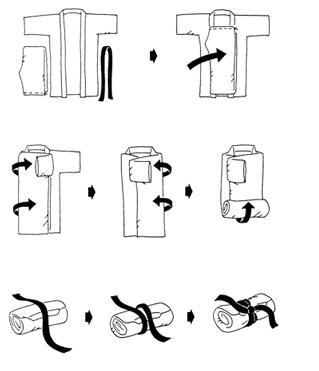
| How to Fold the gi | |||||
|
|
|||||


Quick Contact
Follow Us :